Hempcrete Is in the American Code Book. In Three Places, It Is Actually Law.

Updated: Aug 19
How the material crossed the Channel, then the Atlantic, and what “approved in 49 states” really means
By Shawn Ledig | U.S. Hemp Building Association
Part three of three, in two installments. This is the first. Part two ended in France, with an insurance classification.
France took twenty-six years to turn a waste product into something an insurer would write without asking questions, from Charles Rasetti’s first hemp-lime infill at
Nogent-sur-Seine in 1986 to the 2012 decision that put the material on the list of accepted techniques French insurers and inspection bureaus work from. That is where part two left off, and it is worth holding onto, because the American story is not a continuation of it. It is a different solution, arrived at in a different order, and we are still finding out what that cost us.
Between the French rulebook and the American code book there is a stop in England.
The Crossing
Around 2001 the Suffolk Housing Society finished eighteen dwellings at Haverhill. Sixteen went up in conventional masonry, two in hemp-lime. The point was never the two houses. The point was the sixteen, near-identical controls on the same site, so the Building Research Establishment could measure the pair against a fair comparison.
The results were more interesting than a clean win. On paper the hemp-lime houses scored worse, a SAP rating of 77 against 87. In occupation they used less energy, and the walls outperformed their notional U-value. That gap between the calculated number and the measured behavior is the oldest argument in this material, and Haverhill is where it first showed up in English with data attached. BRE put the true cost of the hemp-lime houses at about $70 per square foot of floor against $64 for traditional construction, £526 against £478 per square metre, about 10 percent more, and most of that difference was labour.
Five years later the material got its commercial proof. Adnams, the Suffolk brewer, completed a distribution centre at Reydon in September 2006, with 19-inch (480 mm) diaphragm walls rising 26 feet (8 metres), built between steel columns, a U-value of 0.18, which is roughly R-32 in our units, a BREEAM Excellent rating, and about $74,000 (£40,000) of added wall cost, which bought a cooling system of almost exactly the same price that never had to be installed at all. A brewery is not an eco-demonstrator. A brewery is a business that needed a warehouse.
Then Britain did the thing that actually mattered, and it is not what an American reader would expect.
In July 2009 Lime Technology bought Hemcore, the Suffolk processor, out of administration, putting supply and binder under one roof. On 2 March 2010, at Ecobuild, the British Board of Agrément presented Lime Technology with the world’s first BBA certificate for a hemp-lime system. Alongside it came warranty acceptance from LABC New Home Warranty and Zurich Building Guarantee, and the BRE’s position that hemp-lime carried nationwide local authority building control approval for buildings up to 39 feet (12 metres) in height, subject to design limitations.
Product certification. Warranty acceptance. Building control approval. Not a code appendix.
Britain answered the same question France answered, which is whether an ordinary builder can do this on an ordinary job without a special conversation, and answered it through an entirely different instrument. Two countries, two routes, same destination.
The English-language vocabulary for all of this was largely assembled in a small town in County Kerry. Steve Allin convened the first International Hemp Building Symposium at Kenmare in September 2009, and out of it came the International Hemp Building Association that November. Allin wrote the book most early American builders actually read. I have a signed copy of it in the office foyer.
The Federal Problem
Here is why America could not simply copy either model.
For most of the period covered in this series, growing the raw material in the United States was a federal crime. Hemp sat inside the Controlled Substances Act, undifferentiated from its intoxicating relative. There was no domestic hurd because there was no domestic crop. The Agricultural Act of 2014 opened the door partway through state research pilots, and the Agriculture Improvement Act of 2018 opened it properly, defining hemp by a threshold of not more than 0.3 percent delta-9 THC.
So while France was drafting professional rules and Britain was collecting a BBA certificate, the American industry was not slow. It was illegal.
That single fact explains everything that followed. The first American hempcrete walls were built with imported material: English hurd, English binder, English technical literature, and a Michigan project as recently as 2022 was sprayed with French hurd. We built a code pathway before we built a supply chain, because for decades we were not permitted to build one.
The First Houses
The building most people mean when they say the first American hempcrete house is in Asheville, North Carolina, finished in 2010: the Martin-Korp house, designed and built by Push Design for former mayor Russ Martin and Karen Korp, with 12-inch Tradical Hemcrete walls. American Lime Technology, which supplied the system, put the cost at $133 per square foot. Hemp Technologies, founded in Asheville in 2008, imported the material for much of that early work, hurd and binder both, out of the United Kingdom.
Then in 2017 Denver permitted its first hempcrete structure, a 320-square-foot post-and-beam workshop designed by Bob Escher, who would go on to become the founding president of this association when it formed in June 2019.
Note that year. Denver permitted a hemp wall five years before the International Code Council voted on anything.
What It Took to Get into the Book
In January 2022 the U.S. Hemp Building Association submitted code change proposal RB316-22, proposing a new appendix to the International Residential Code. Twenty-one named proponents signed on, among them Jacob Waddell, Martin Hammer, David Eisenberg, Anthony Dente, Cameron McIntosh, Henery Gage Jr., Alex Escher, Bob Escher, Sally Warren, Jennifer Martin and Chris Magwood. The IRC Building Committee approved it as modified, seven to two, at the Committee Action Hearings in Rochester, New York in the spring of 2022.
Here is the part that says the most about how it was won. In the ICC’s published final action record for the 2022 Group B cycle, RB316-22 carries the notation AM, which the document’s own legend defines as approved as modified at the committee action hearing. RB316-22 appears exactly once in that record. It is absent from the results of the public comment hearing and online governmental consensus vote, while RB315-22 and RB317-22, the proposals immediately before and after it, both appear there.
No public comment was filed against it, so it never went to the floor at Louisville that September. The committee’s approval was the final action.

There was no floor fight. A well-prepared proposal with twenty-one credible proponents and a properly bounded scope went in, and nobody objected.
That is what winning looks like in code development, and every member of this association should understand it, because the next thing we ask for will be won or lost the same way. Not with passion. With preparation.
It was published as Appendix BL in the 2024 International Residential Code. Which brings me to a small correction: it is Appendix BL, not Appendix BA. The proposal carried the placeholder designation AY, and the published appendix is BL. That error appears in secondary sources and on the project pages of people actually building in this material. If we cannot cite our own code provision consistently, we should not be surprised when plan reviewers struggle to find it.
What Appendix BL Actually Says
Hemp-lime under BL is non-structural, nonbearing infill. It carries no load. The framing carries the load, and the appendix tells you what that framing has to be. Dry density must fall between 12.5 and 25 pounds per cubic foot, which is 200 to 400 kilograms per cubic metre, with prescriptive thermal values running from R-2.10 per inch at the low density down to R-1.20 at the high.
Two provisions are worth understanding rather than memorizing. Wall bracing is restricted to let-in bracing, Method LIB, because solid sheathing is not vapor-open. And membranes between the plaster and the hemp-lime are prohibited, with narrow exceptions. A hemp-lime wall has to breathe or it will hold water, and the appendix is built around that single principle. Read BL103.7.1 and BL104.3.1 together before you detail a wall, because the exceptions are where people get into trouble.
The original appendix carried no fire rating. That is being fixed, and the way it was fixed is instructive. In October 2025, at the ICC hearings in Cleveland, the eleven-member IRC committee voted unanimously, eleven to nothing, to add one-hour fire-rated hemp-lime assemblies to Appendix BL of the 2027 IRC: three assemblies, each backed by a one-hour ASTM E119 test run at Intertek in York, Pennsylvania, in 2024 and 2025. Let us also be accurate about who paid for what. The fire testing was funded through a U.S. Army SBIR Phase II award of roughly $1.9 million to Americhanvre. Our community (HempBuild Magazine, Hemp Build School, USHBA, and other industry representatives) separately crowdfunded about $12,000 for the code advocacy that carried the results into the hearing room. Both are worth being proud of. They are not the same thing, and we should stop describing the tests themselves as "crowdfunded."
Cleveland was not the only stop in that cycle, and the earlier one deserves a mention because it is the kind of work nobody writes about. At the Group B committee action hearings in Orlando, held from 27 April to 6 May 2025, a quieter clarification was approved: plaster now counts when a hemp-lime wall is classified as a mass wall. That sounds like housekeeping. It is not. Mass walls carry lower R-value requirements in most climate zones, so the change lets a hemp-lime assembly earn its thermal compliance on the merits it actually has, without anyone changing how the wall is built. Orlando in the spring, Cleveland in the fall. One made the appendix easier to comply with, the other made it fire-rated. Neither is adoption, and both still have to survive public comment before the 2027 IRC goes to print.
Three Jurisdictions, Not Forty-Nine
Now the correction I most want to make, and I am making it as the president of the association that benefits most from the misunderstanding.
You will hear, constantly, that hempcrete is approved in forty-nine states. It is not a true statement, and repeating it does us damage.
Section R101.2.1 of the 2024 IRC provides that provisions in the appendices do not apply unless they are specifically adopted. That rule is not new to this cycle, incidentally: it is the 2021 IRC’s section R102.5, renumbered. Appendices are a menu. Publication in the model code is not adoption.
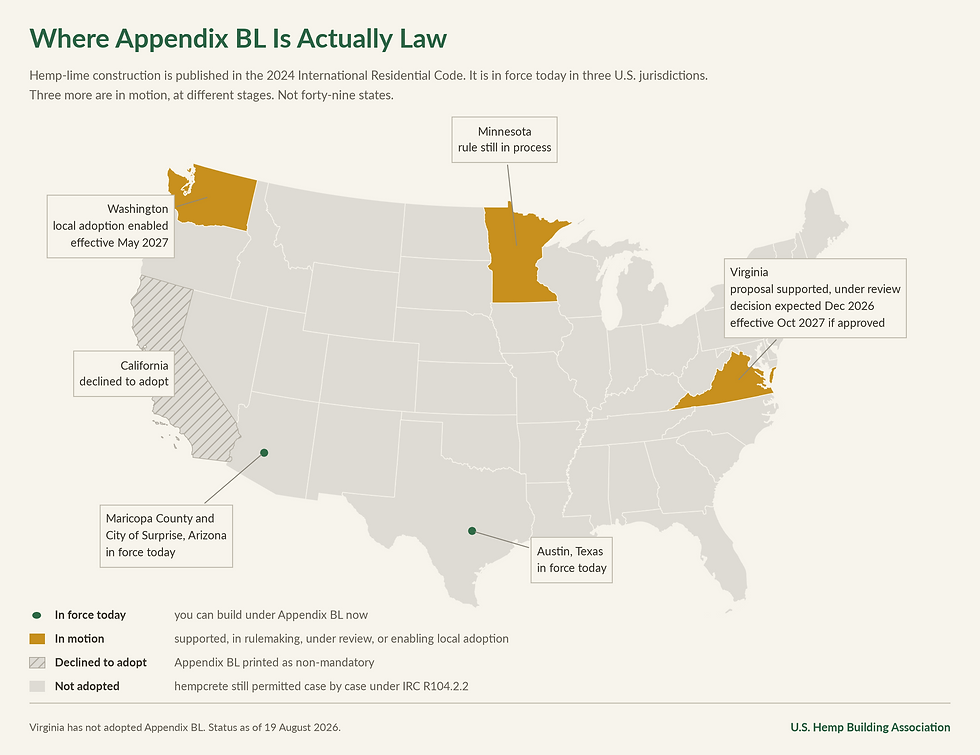
Here is the honest count as of this writing, and it is better than it was six months ago. Appendix BL is in force today in three places. Austin, Texas added it by council amendment in April 2025, effective that July, the first major American city to do so. In Arizona, both Maricopa County and the City of Surprise carry it in their 2026 residential code documents. Three more are in motion, at different stages, and it is worth being precise about which.
Minnesota's technical advisory group approved it eight to one in July 2025, but the rule is still working through the state's process, which means Minnesota has not adopted Appendix BL yet, whatever you may have read to the contrary. Virginia's Board of Housing and Community Development voted unanimously on January 6, 2026 to support the proposal, submitted single-handedly by Virginia builder Scott McStacy. The change is now under review, with a decision expected in December and, if approved, an effective date of October 2027. Washington took a different route again: its 2024 proposal became a new section of the state code that, when it takes effect in May 2027, will make Appendix BL available for adoption by local jurisdictions.
Three jurisdictions where you can build under BL today. Three more on the calendar. Not forty-nine states.
And California, which is the case I want every member to sit with, declined. In its rulemaking record for the 2024 triennial cycle, the Department of Housing and Community Development stated that it proposes not to adopt Appendix BL, and the appendix is printed in the 2025 California Residential Code as non-mandatory, which is another way of saying not adopted. I have also seen it reported that the State Fire Marshal separately recognized hemp-lime as an approved non-combustible material. That would be a real partial win, and I could not confirm it in a primary document.
Before that reads as pure discouragement, here is the other half. AIA Austin’s own letter supporting adoption conceded that the city had already permitted multiple hempcrete residences under alternative provisions. Portland, Oregon granted building appeal 18046 as proposed, hempcrete on a timber frame with lime plaster serving as the water-resistive barrier and the rainscreen omitted, decided under the 2008 Oregon Residential Specialty Code, years before BL existed. The alternative materials, design and methods provision, R104.11 in the 2021 IRC and renumbered R104.2.2 in 2024, was doing this work before Appendix BL and is still doing most of it now.
So the honest framing is this. Appendix BL did not make hempcrete legal. It made hempcrete routine in a handful of places, and considerably easier to argue everywhere else. That is a real achievement. It is not the achievement we have been describing.
That is the state of the code. It is not the state of the industry.
The second installment of this chapter takes up the harder half. The American buildings that are already standing. The county that said no in the middle of a rebuild. And the question nobody in this business is asking out loud, which is who is going to write the mortgage.
Bring Your Questions
If you have permitted a hempcrete project in the United States, or been told you could not, I want to hear from you. The count in this piece is accurate as of today, and it will be out of date by winter. I would rather hear about a new adoption from a member than find it six months later.
The Board is finalizing the date for the next members’ call and will announce it shortly. When it lands, the adoption map is going on the agenda as a real discussion item, jurisdiction by jurisdiction, rather than a comment at the end when everyone is tired.
One specific request. If anyone holds the primary document showing that the California State Fire Marshal recognized hemp-lime as an approved non-combustible material, send it to me and I will print it with the citation.
Send your questions ahead of time so we come prepared with real answers: shawn@ushempbuilding.org
Onward,
Shawn Ledig
President, U.S. Hemp Building Association
A Note on the Historical Record
One claim commonly repeated in our industry is not printed above because I could not verify it: that Tradical hemp-lime went into a community centre at Pine Ridge, South Dakota in 2008. There is an archived headline for an American Lime Technology press release dated 11 May 2008 announcing a Tradical Hemcrete community facility in South Dakota, but the release itself is no longer retrievable and it does not name Pine Ridge. Separately, and better documented, hempcrete blocks imported from Europe were used on a house at Pine Ridge for Sioux elder Ernest Afraid of the Bear beginning in April 2000. If you have that 2008 release, or photographs, send them. It would be nice to have in our records/archives.
Correction
August 19, 2026: an earlier version of this article described Virginia as having adopted Appendix BL. Virginia has not adopted it. The Board of Housing and Community Development voted to support the proposal, which remains under review, with a decision expected in December and, if approved, an effective date of October 2027. The text has been updated to reflect this.
Sources
Suffolk Housing Society Haverhill hemp-lime trial, BRE monitoring, SAP ratings and in-use energy. Passive House Plus, lime-hemp. https://passivehouseplus.co.uk/articles/sustainable-building-technology/lime-hemp
Haverhill cost comparison, £526 per square metre against £478, citing BRE 2001. Ranyl Rhydwen, Building with Hemp and Lime. https://www.votehemp.com/wp-content/uploads/2018/09/building_with_hemp_and_lime.pdf
Adnams case study: completion September 2006, walls built between steel columns. Rachel Bevan and Tom Woolley, Hemp Lime Construction: A Guide to Building with Hemp Lime Composites, EP 85, IHS BRE Press, Bracknell, 2008, ISBN 978-1-84806-033-3, case study 3.1. Note that this source gives the wall height as 15 metres, while the contemporaneous trade press reports 8 metres; the lower and better-corroborated figure is used above. https://researchportal.bath.ac.uk/en/publications/hemp-lime-construction-a-guide-to-building-with-hemp-lime-composi/
“The 480mm thick, 8m high warehouse diaphragm walls were built from two skins of blocks,” and over 150 tonnes of carbon dioxide locked within the walls. Fabric Architecture, 1 May 2008. https://fabricarchitecturemag.com/2008/05/01/brewer-distribution-center-acclaimed-as-britains-greenest-warehouse/
Project value of £5.8 million for the single-storey warehouse. Building, Sustainable Building of the Year, 19 November 2007. https://www.building.co.uk/news/sustainable-building-of-the-year-largest-project/3096480.article
Adnams distribution centre: 480 mm walls of two skins of block, hemp-lime infill, U-value 0.18 W/m²K, and the decision to design out cooling and mechanical ventilation entirely. Building, 4 September 2006. https://www.building.co.uk/innovative-adnams-distribution-centre-minimises-environmental-impact/3072978.article
Adnams achieved a BREEAM Excellent rating. Aukett Swanke, the project architect, formerly Aukett Fitzroy Robinson. https://www.aukettswanke.com/journal/sustainability-reflections-2/
The £40,000 wall premium and the comparably priced cooling system it displaced are as reported in the hemp-lime trade literature rather than in the BRE record, and should be read on that footing. Australian Hemp Masonry Company. https://www.hempmasonry.com.au/energy-efficient-hempcrete-building-materials/
Lime Technology’s acquisition of Hemcore, July 2009. Renewable Carbon News. https://renewable-carbon.eu/news/lime-technology-buys-hemp-fibre-producer-hemcore/
World’s first BBA certificate for a hemp-lime system, presented at Ecobuild, 2 March 2010. American Lime Technology. http://www.americanlimetechnology.com/tradical-hemcrete-achieves-worlds-first-hemp-lime-bba-accreditation/
Zurich Building Guarantee approval for the Tradical Hemcrete system. GreenSpec. http://www.greenspec.co.uk/green-products/in-situ-composites/details/tradical-hemcrete/
Nationwide local authority building control approval to 12 metres, subject to design limitations. BRE Information Paper IP14/11. https://files.bregroup.com/bre-co-uk-file-library-copy/filelibrary/pdf/projects/low_impact_materials/IP14_11.pdf
First International Hemp Building Symposium, Kenmare, September 2009. International Hemp Building Association archive. https://internationalhempbuilding.org/wp-content/uploads/2018/07/steve-allin-first-symp-1.pdf
International Hemp Building Association formed 20 November 2009. IHBA. https://internationalhempbuilding.org/about/
Agriculture Improvement Act of 2018, P.L. 115-334. https://www.congress.gov/bill/115th-congress/house-bill/2
Definition of hemp, 7 U.S.C. §1639o. https://www.law.cornell.edu/uscode/text/7/1639o
Martin-Korp residence, Asheville: 12-inch Tradical Hemcrete, $133 per square foot, 3,400 square feet. American Lime Technology. http://www.americanlimetechnology.com/martin-korp-residence/
Push House, Asheville, as the first permitted U.S. home with hempcrete exterior walls. WNC Magazine. https://wncmagazine.com/feature/design_leap
Hemp Technologies founded in Asheville in 2008. HempTech Global. https://hemptechglobal.com/about-us
Imported UK hurd and binder in the 2010 Asheville houses. HempBuild Magazine. https://www.hempbuildmag.com/home/2013-hemp-building-documentary-was-ahead-of-its-time
Denver’s first permitted hempcrete structure, 2017, and Bob Escher as founding president of the U.S. Hemp Building Association. NAHB. https://www.nahb.org/blog/2023/07/cannabis-in-your-walls
WNDER Workshop, Denver, 2017. Escher Design. http://www.escherdesigninc.com/about.html
RB316-22 proposal text and the full list of twenty-one named proponents. https://hemptoday.net/wp-content/uploads/2023/02/IRC-Appendix-hempcrete.pdf
Committee approval as modified, seven to two, at the 2022 Group B Committee Action Hearings, Rochester. ICC Report of the Committee Action Hearing Results. https://www.iccsafe.org/wp-content/uploads/2022-Group-B-Report-of-the-Committee-Action-Hearing-Results-Complete.pdf
Final action results for the 2022 Group B cycle, including the online governmental consensus vote. ICC. https://www.iccsafe.org/wp-content/uploads/2022-Group-B-Final-Action_incl-OGCV.2.pdf
2024 IRC section relocation table, showing R101.2.1 carried forward from 2021 R102.5 and R104.11 renumbered to R104.2.2. ICC. https://shop.iccsafe.org/media/wysiwyg/material/3100S24-TOC.pdf
2024 International Residential Code, Chapter 1, scope and administration. ICC. https://codes.iccsafe.org/content/IRC2024P1/chapter-1-scope-and-administration
Appendix BL as published in the 2024 International Residential Code: density and general scope, thermal performance, finishes and membranes, mechanical performance. ICC (canonical text, subscription required). https://codes.iccsafe.org/content/IRC2024P1/appendix-bl-hemp-lime-hempcrete-construction — the freely readable verbatim printing is California’s reproduction of the same appendix text in the 2025 California Residential Code, carrying that state’s non-mandatory disclaimer discussed above. https://gocodebook.com/library/us/ca/ca-residential-code/appendix-bl-hemp-lime-hempcrete-construction
Approval at the earlier Orlando hearings of clarifications to include plaster when classifying a hemp-lime wall as a mass wall, and the lower R-value requirements that mass wall classification carries in most climate zones. HempBuild Magazine, 26 October 2025. https://www.hempbuildmag.com/home/irc-2027-hempcrete
Dates and venue of the 2025 Group B Committee Action Hearing #1, 27 April to 6 May 2025, Orlando, Florida. ICC. https://www.iccsafe.org/wp-content/uploads/2025-Group-B-Introduction.pdf
Unanimous eleven to nothing committee approval of fire-rated hemp-lime wall assemblies for Appendix BL of the 2027 IRC, Cleveland, 23 October 2025. ICC Report of the Committee Action Hearing, CAH #2. https://www.iccsafe.org/wp-content/uploads/2025-REPORT-OF-THE-COMMITTEE-ACTION-HEARING-CAH-2.pdf
2025 Group B IRC monograph, hemp-lime assembly text and the three ASTM E119 test reports. ICC. https://www.iccsafe.org/wp-content/uploads/2025_Group_B_IRC_Building-compressed.pdf
ASTM E119 hemp-lime fire testing and its U.S. Army SBIR funding, with the crowdfunded code-advocacy campaign. HempBuild Magazine. https://www.hempbuildmag.com/home/irc-2027-hempcrete
City of Austin resolution adopting the 2024 building codes with local amendments, April 2025, effective July 2025. https://services.austintexas.gov/edims/document.cfm?id=477212
Austin technical code amendments and effective date. City of Austin Development Services. https://www.austintexas.gov/development-services/building-technical-codes
Maricopa County, Arizona residential code addenda adopting Appendix BL. https://www.maricopa.gov/AgendaCenter/ViewFile/Item/10471?fileID=102475
City of Surprise, Arizona code document adopting Appendix BL in its entirety. https://content.civicplus.com/api/assets/az-surprise/344d569f-02e5-4c61-a40d-31dbc21580a3
Minnesota technical advisory group vote of eight to one, July 2025. Carbon Leadership Forum. Note that the thread is titled as an adoption; the vote was a technical advisory group recommendation, not adoption. https://community.carbonleadershipforum.org/t/mn-adopts-hempcrete-and-strawbale-in-residential-building-codes/9255
The Minnesota proposal to adopt Appendix BL, submitted 31 March 2025, which states plainly that “currently however, Hemp-Lime wall assemblies are not permitted by code in Minnesota.” Minnesota Department of Labor and Industry, residential technical advisory group handout. https://www.dli.mn.gov/sites/default/files/pdf/TAG-residential-040825-handouts1.pdf
Minnesota rulemaking still open as of 12 January 2026: Appendix BL listed under “adding hemp lime construction,” with next steps given as posting the dual notices for rule adoption and finalising the rule, and new codes expected late 2026. Minnesota Department of Labor and Industry, 2026 CCLD Annual Update, slides 30 and 34. https://www.dli.mn.gov/sites/default/files/pdf/2026-ccld-update.pdf
Virginia code change RB339-24 approved as submitted, July 2026. Home Builders Association of Virginia code change tracker, August 2026. https://hbav.com/wp-content/uploads/2026/08/2024-Code-Development-Cycle_Code-Change-Update_August-2026.pdf
Virginia Board of Housing and Community Development unanimous vote to adopt Appendix BL, 6 January 2026, on a proposal submitted by Scott McStacy. HempBuild Magazine. https://www.hempbuildmag.com/home/va-hempcrete-approval
Washington proposal 24-GP1-015 for adoption of IRC appendices BI, BJ, BK and BL. Washington State Building Code Council. https://sbcc.wa.gov/sites/default/files/2024-09/24-GP1-015.pdf
Washington rulemaking creating WAC 51-51-6000, making Appendix BL available for local adoption, effective May 2027. Washington State Register 26-10-071. https://lawfilesext.leg.wa.gov/law/wsr/2026/10/26-10-071.htm
California HCD initial statement of reasons, 2024 triennial cycle, proposing not to adopt Appendix BL. https://www.dgs.ca.gov/-/media/Divisions/BSC/03-Rulemaking/2024-Triennial-Cycle/Public-Comments/BFO-SDLF-HF-45-Day/HCD/HCD-07-24-45-Day-ISOR-PT2_5.pdf
AIA Austin letter of support, noting hempcrete residences already permitted under alternative provisions. https://aiaaustin.org/wp-content/uploads/2022/02/25.04.01-AIA-Austin-Lettter-of-Support_Hempcrete-Residential-Construction.pdf
City of Portland appeal 18046, granted as proposed. Portland Bureau of Development Services. https://www.portlandoregon.gov/bds/appeals/index.cfm?action=entry&appeal_id=18046
French revival chronology: 1986 Nogent-sur-Seine, 1998 founding of Construire en chanvre, 2007 provisional professional rules, 2012 acceptance as a current technique. Bâtimétiers 68, Fédération Française du Bâtiment. https://www.ffbatiment.fr/revues-guides/bam/68-septembre-2022/le-chanvre-une-filiere-en-devenir
Archived headline, American Lime Technology press release of 11 May 2008 on a Tradical Hemcrete community facility in South Dakota, location unstated. The Hemp Report news archive. http://www.hempreport.com/subscribers/newsarchives.html
Hempcrete blocks used on a Pine Ridge house for Ernest Afraid of the Bear from April 2000. NoCo Hemp Expo. https://www.nocohempexpo.com/celebrate-first-hemp-house-built-america-today/
Currency conversions from pounds sterling are made at contemporaneous annual average exchange rates, $1.44 to the pound for 2001 and $1.84 for 2006. Metric figures are as published in the original sources; imperial and dollar equivalents are rounded. Macrotrends, GBP/USD historical annual data. https://www.macrotrends.net/2549/pound-dollar-exchange-rate-historical-chart
Shawn Ledig is a structural engineer, President of the U.S. Hemp Building Association, Board Chairman of the Louisiana Industrial Hemp Promotion and Research Advisory Board, and founder of Delta AgroFiber Solutions LLC in Mandeville, Louisiana.


Comments